
My parents called my husband “”half a man”” because of his height for twelve years until they went broke—when they asked him for a $20,000 check, his one condition left them shocked.
💔 💔
I’ll never forget the look on my mother’s face at my wedding twelve years ago. It was embarrassment, the kind she couldn’t even hide. My husband, Jordan, was born with achondroplasia, and to my parents, that was a “”stain”” on the family name. They didn’t care that he was a brilliant architect or that he treated me with more kindness than anyone ever had. To them, he was someone to crop out of photos and joke about behind his back.
My father didn’t even try to be subtle. During his toast, he laughed about hoping our future children would “”actually be able to reach the dinner table.””
It didn’t stop there. They mocked him for growing up in an orphanage after being abandoned by his biological parents. Over time, I pulled away, calling less and visiting rarely, because every interaction came with another jab and another reminder that the man I loved would never be good enough for them.
Jordan never fought back; he simply kept building his life—quietly, steadily, successfully.
Then everything changed. My parents’ business collapsed under debt, and within months, they lost nearly everything they had spent decades bragging about. Last Tuesday, they showed up at our door looking desperate, and suddenly very polite.
They didn’t come to apologize. They came because they had heard Jordan’s firm had landed a massive contract and needed $20,000 to keep the bank from seizing their condo.
I was ready to throw them out, but Jordan calmly invited them in for tea and listened to their complaints for two hours. Then he went to his office and returned with a check already written out.
$20,000.
My mother’s eyes lit up as she reached for it, but Jordan gently pulled it back.
“”You can have this,”” he said evenly, “”right here, right now… but only if you fulfill ONE CONDITION.””
The room went silent. My parents exchanged a glance, their confidence slipping.
“”What condition?”” my father asked, his voice shaking.
READ THE REST OF STORY IN THE FIRST COMMENT👇👇‼️

I will never forget the expression on my mother’s face at my wedding.
She wasn’t proud or emotional. She looked embarrassed, as though my marriage were a public humiliation she had been forced to endure.
My husband, Jordan, was born with achondroplasia, a form of dwarfism. To my parents, that mattered more than his kindness, intelligence, or accomplishments.
They didn’t care that he was a gifted architect who had built his career from nothing. They didn’t care that he treated me with more love and respect than anyone else ever had.
To them, Jordan was someone to leave at the edge of family photographs and mock when they thought I couldn’t hear.
At our reception, my father stood with a microphone in one hand and a glass of champagne in the other.
“To the newlyweds!” he announced.
Then he grinned.
“Let’s hope their future children are tall enough to reach the dinner table.”
A few guests laughed nervously. Most stared down at their plates.
My face burned with anger, but Jordan only reached beneath the table and squeezed my hand.
“Don’t let him ruin tonight,” he whispered.
“How can you be so calm?” I asked.
His smile was gentle but tired.
“Because I’ve heard worse.”
Those words broke my heart more than my father’s joke.
Jordan had grown up in an orphanage after his biological parents abandoned him. He rarely discussed it, but one evening during dinner, he finally told my parents about his childhood.
I expected them to show compassion.
Instead, my father smirked.
“Well,” he said, “I suppose we all understand why they left you there.”
I stared at him in disbelief.
“Are you serious?”

“It was a joke, Jennifer,” he replied. “Jordan knows how to laugh at himself.”
“No,” I said, pushing back my chair. “You laugh at him. That’s different.”
My mother rolled her eyes and accused me of being overly sensitive.
That evening changed everything.
I stopped visiting as often. I answered fewer calls and declined most invitations. Every conversation with my parents contained another insult disguised as humor.
Jordan never retaliated.
He simply continued building his life.
He worked late nights, accepted difficult projects others avoided, and eventually opened his own architectural firm. He hired talented people who had often been overlooked because of disabilities, physical differences, or unconventional backgrounds.
Over twelve years, his small office grew into a respected company.
Then my parents’ business collapsed.
At first, my mother sent vague messages about temporary financial problems. Soon, they sold their expensive cars. Their vacations stopped, and the photographs of luxury resorts disappeared from social media.
Then, last Tuesday evening, they appeared at our front door.
My father’s suit was wrinkled. My mother clutched her handbag with both hands.
For once, neither of them was smiling.
“Jordan,” my mother began softly, “we heard your company recently secured a major contract.”
Jordan said nothing.
“We’re in trouble,” Dad admitted. “The bank is about to seize our condo. We only need twenty thousand dollars to stop the process.”
Only twenty thousand dollars.
They said it as though they were asking to borrow a cup of sugar.
I folded my arms.
“You spent twelve years insulting him, and now you’re asking him for money?”
“We’re family,” Mom replied.
“You never treated him like family.”
Jordan gently touched my arm.
“Let them come inside.”
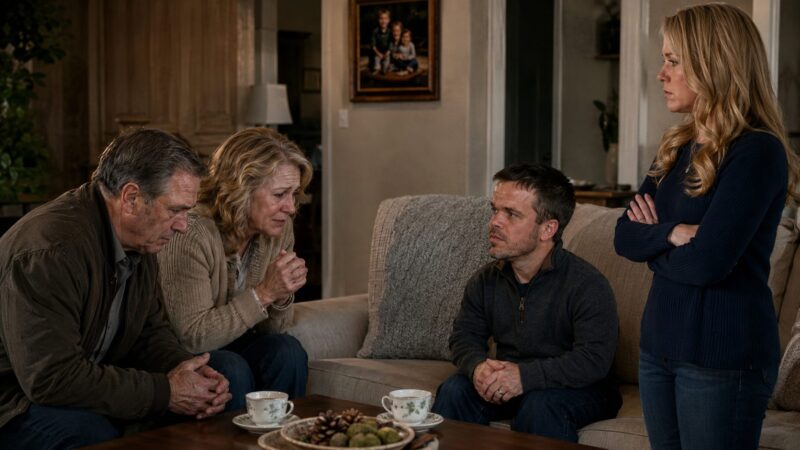
We sat in the living room while my parents explained their financial collapse. They blamed the market, dishonest partners, rising expenses, and bad luck.
They blamed everyone except themselves.
Not once did they apologize.
After nearly two hours, Jordan stood and entered his office.
He returned holding a check.
My mother’s eyes widened when she saw the amount.
Twenty thousand dollars.
She immediately reached for it, but Jordan pulled his hand back.
“You may have this,” he said calmly, “but only under one condition.”
My parents exchanged a nervous glance.
“What condition?” Dad asked.
“I want a sincere apology for the way you’ve treated me.”
Dad’s shoulders relaxed.
“That’s all? Fine. I’m sorry, Jordan.”
Mom nodded quickly.
“We’re sorry if any of our jokes offended you.”
“If?” I repeated.
She looked at me impatiently.
“We never meant any harm.”
Twelve years of cruelty had been reduced to a few empty sentences because they wanted a check.
I reached over and took it from Jordan’s hand.
“No.”
My mother blinked.
“What do you mean, no?”
“You don’t get to erase twelve years of humiliation with a twelve-second apology.”
“We apologized,” Dad snapped.
“You said what you thought Jordan wanted to hear.”
My father turned toward Jordan.
“Are you going to let her speak for you?”
Jordan didn’t hesitate.
“My wife and I make decisions together. If Jennifer believes my condition wasn’t enough, I trust her.”
For the first time, my parents understood that they no longer controlled the room.
I placed the check on the table.
“You want our help? Spend one week at Jordan’s company.”
My mother frowned.
“Doing what?”
“Listening. Observing. Meeting the people who work there and learning what they have accomplished despite being underestimated by people like you.”
Dad’s expression hardened.
“We don’t need jobs.”
“You won’t be working,” I said. “You’ll simply spend five days seeing the world you’ve mocked without ever trying to understand it.”
Mom stared at me as though I had proposed something unbearable.
“This is humiliating.”
“Why?” I asked. “Because you’ll be surrounded by people with disabilities?”
Neither of them answered.
Jordan leaned forward.
“My company was built by people who were repeatedly told they were too different, too weak, or too inconvenient to succeed. Many of them are among the most talented professionals I’ve ever met.”
My father suddenly stood.
“We’re not spending a week in some circus just to get money from you.”
Silence filled the room.
There it was.
The truth.
No joke. No nervous laughter. No attempt to pretend he had been misunderstood.
My mother touched his arm.
“He didn’t mean it that way.”
“Yes, he did,” I said.
I pointed toward the door.
“You need to leave.”
Dad glared at Jordan.
“I suppose I shouldn’t expect a half-sized man to wear the pants in his own marriage.”
“Get out!” I shouted.
My mother pulled him toward the hallway, but before leaving, she turned back to us.
“You’re really going to let us lose our home?”
Jordan looked directly at her.
“You were willing to apologize for money, but you weren’t willing to learn. That tells me your apology meant nothing.”
The door closed behind them.
For several seconds, neither Jordan nor I spoke.
The untouched check remained on the table.
“I’m sorry,” I finally whispered. “You gave them a chance, and they insulted you again.”
Jordan took my hand.
“No. They gave us clarity.”
The following month, we donated the twenty thousand dollars to a housing program for young adults with disabilities who had aged out of foster care.
When my parents learned what we had done, they called it cruel.
But Jordan didn’t see it that way.
“The money still helped a family,” he said. “Just not one that believed cruelty should be rewarded.”
That was the moment I understood the lesson he had been trying to teach them.
Respect cannot be purchased with a desperate apology.
And being family does not give anyone the right to destroy another person’s dignity—and then demand a check when their own pride finally costs them everything.