My Son Rolled His Eyes and Giggled at Our Waiter with Down Syndrome — So I Taught Him a Lesson He’ll Never Forget
He was extremely focused and took his job very seriously.
My heart sank right into my stomach.
I immediately put my credit card down on the table, apologized profusely to Sam, tipped him generously, and asked for the bill.
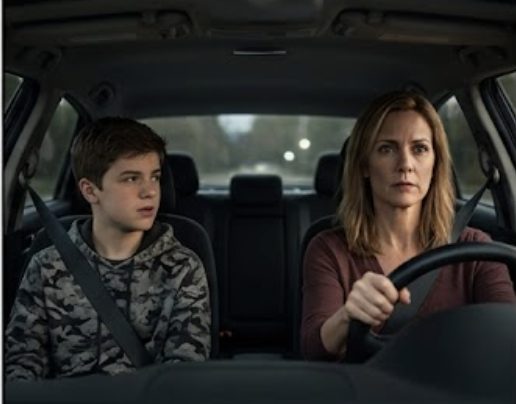
The atmosphere in the car was suffocatingly TENSE.
I walked into my bedroom, reached into the back of my closet, and pulled out an old, faded wooden BOX that I hadn’t opened in nearly twenty years.
THE REST OF STORY IN THE FIRST COMMENT 👇👇‼️
I took my fourteen-year-old son, Leo, to his favorite steakhouse to celebrate the best report card he had ever brought home.He had earned straight A’s, his basketball coach called him a natural leader, and his teachers praised his discipline. I had worked two extra weekend shifts at the hospital to afford the dinner, but seeing his excited smile made every exhausting hour worthwhile.
“Mom, you didn’t have to do this,” he said as we entered.
“I wanted to.”
“You know I’m ordering the biggest steak.”
“I expected nothing less.”
He laughed and wrapped an arm around my shoulders.
“You’re the best.”
For a few minutes, everything felt perfect.
Then our waiter approached.
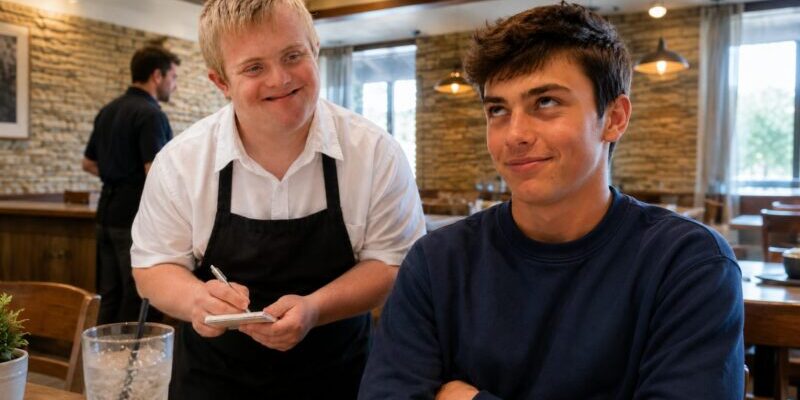
He was a young man in his early twenties. His name tag read Sam, and he held his order pad carefully with both hands. He had Down syndrome, and although his words came slowly, his smile was warm and confident.
“Good evening,” he said. “My name is Sam. I’ll be taking care of you tonight. I’m still learning.”
“It’s nice to meet you, Sam,” I replied.
His shoulders relaxed.
Then he looked at Leo.
“What would you like to drink?”
Leo glanced at me with a tiny smirk before ordering lemonade.
A knot formed in my stomach, but I told myself I was imagining things.
A few minutes later, Sam returned with our drinks and began describing the special.
“Tonight, we have grilled sir… sirloin.”
He paused, embarrassed.
“Sorry. I sometimes get stuck on that word.”
“You did just fine,” I assured him.
Then I heard Leo snort.
He covered his mouth, but his shoulders were shaking with laughter.
I kicked him lightly beneath the table.
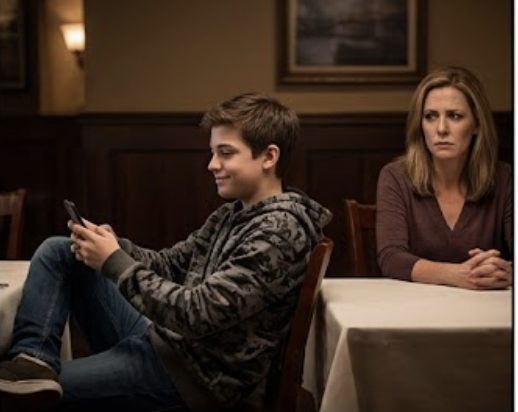
He looked at me, rolled his eyes, and turned back to his phone.
When Sam walked away, Leo started typing rapidly.
“What are you doing?” I asked.
“Nothing.”
“Show me.”
With an exaggerated sigh, he turned the screen toward me.
He had texted his friend:
This waiter is moving in slow motion. I’ll be old before my steak gets here.
A laughing emoji followed.
Then another message appeared:
Pretty sure I could do his job faster.
“Delete it,” I said.
“Oh, come on. It’s just a joke.”
“It isn’t funny. It’s cruel.”
“He’ll never see it.”
“That doesn’t make it acceptable.”
Before I could say more, Sam returned carrying a basket of bread.
“I hope you enjoy,” he said carefully.
The moment Sam turned around, Leo imitated his posture and slow steps.
“I hope… you enjoy,” he whispered before giggling.
The couple at the next table stared at him in horror.
My face burned with shame.
I reached into my purse, placed my credit card on the table, and called Sam back.
“I’m sorry,” I told him.

He looked confused.
“For what?”
“For the way my son behaved.”
Sam’s smile faded.
“Oh. I didn’t know if maybe…”
He stopped speaking.
That unfinished sentence told me everything.
He had noticed.
He had simply chosen to pretend he hadn’t.
“We’re leaving,” I said. “Please bring the bill.”
“But your dinner hasn’t arrived.”
“I’ve lost my appetite.”
I paid for the meal and left a tip larger than the bill. Sam tried to object, but I shook my head.
“You deserved much better tonight.”
Leo followed me into the parking lot, muttering angrily.
During the entire drive home, he complained that I was overreacting.
“It was just a joke,” he insisted. “You’re acting like I committed a crime.”
I remained silent.
When we reached home, he tried to go upstairs.
“Sit at the kitchen table,” I said.
“For what?”
“You’ll see.”
I went to my bedroom and pulled a faded wooden box from the back of my closet. I hadn’t opened it in almost twenty years.
When I placed it on the kitchen table, Leo’s sarcastic expression disappeared.
“What’s that?”
“The biggest mistake I ever made.”
Inside were old photographs, handwritten letters, a faded friendship bracelet, and a worn birthday card.
Leo picked up a photograph showing me as a teenager beside a smiling boy in a bright blue shirt.
The boy had Down syndrome.
“Who is he?”
“His name was Daniel. He was my best friend.”
I explained that I had met Daniel when I was sixteen, shortly after my father died. Grief had made me quiet and withdrawn. My friends didn’t know how to help, so most of them slowly disappeared.
Daniel didn’t.
He sat beside me during lunch every day. He shared his sandwiches, remembered my favorite candy, and told terrible jokes until I laughed.
“He never asked me to stop being sad,” I said. “He simply refused to let me be sad alone.”
Leo looked down at the photograph.
“What happened to him?”
I held the friendship bracelet Daniel had spent two weeks making for me.
“The popular girls made fun of him constantly. They imitated the way he spoke and asked why I wasted my time with him.”
One Friday afternoon, I was standing with those girls when Daniel crossed the parking lot toward us.
He saw me and smiled.
The girls immediately began laughing.
“Here comes your boyfriend,” one said.
“Maybe he’ll teach your children how to talk,” another added.
I should have defended him.
I should have walked away.
Instead, desperate to be accepted, I laughed with them.
It lasted only two seconds.
But Daniel heard me.
“I watched his smile disappear,” I whispered. “He looked directly at me. He wasn’t angry. He just looked hurt. Then he turned around and walked away.”
Leo’s eyes filled with tears.
“Did you apologize?”
“I tried. But Daniel never returned to school. His mother had accepted a job in another state, and they moved that weekend.”
I handed Leo the final letter Daniel had written.
Dear Emma,
Thank you for being my friend. You always made school better. I hope you smile lots.
Your friend, Daniel.
Leo read it twice.
“He still called you his friend?”
I nodded.
“That made it hurt even more.”
Leo covered his face.
“I didn’t think about how Sam felt.”
“Neither did I when I laughed at Daniel. The girls called it a joke too. They probably forgot about it the next day. But Daniel remembered. And so did I.”
Leo began crying.
“I want to fix it.”
“You can’t erase what happened.”
“But I can apologize.”
The following afternoon, we returned to the restaurant.
When Sam saw us, uncertainty crossed his face.
Leo walked directly toward him.
“I’m not here to eat,” he said. “I came to apologize.”
Sam listened quietly.
“What I did was cruel,” Leo continued. “You were working hard, and I made fun of you because I wanted someone else to laugh. You didn’t deserve that. I’m ashamed of myself.”
Sam studied him for a moment.
Then he held out his hand.
“Thank you for coming back.”
Leo shook it.
“Can we start over?”
Sam smiled.
“I’d like that.”
Several weeks later, Leo began volunteering at a recreation program for teenagers and adults with developmental disabilities.
After his first day, he came home exhausted.
“They destroyed me at basketball,” he said.
“Every game?”
“Every single one.”
Then he smiled.
“But they cheered for me anyway.”
The wooden box still sits in my closet, but I no longer need to open it.
Sometimes the greatest regret of your life becomes the most important lesson you can pass on.
And sometimes the people the world underestimates are the ones who teach us the most about patience, forgiveness, and kindness.