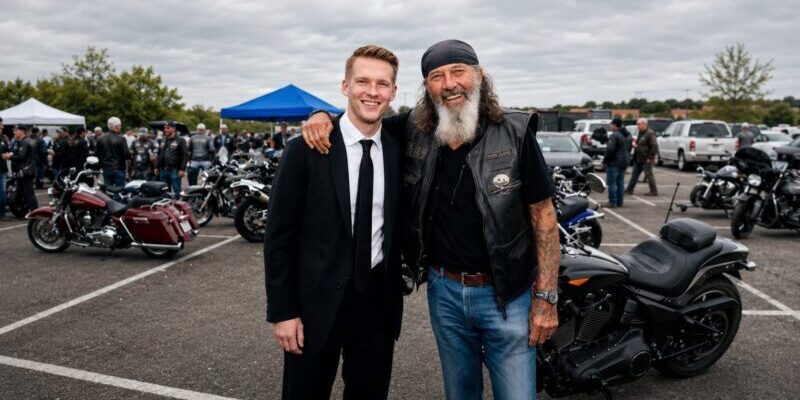
The Biker Who Raised Me Wasn’t My Father—He Was the Dirty Mechanic Who Found Me Sleeping in His Dumpster at Fourteen… 💔💔
When I was fourteen, I ran away from my fourth foster home with nothing but a torn backpack and the clothes on my back.
For three weeks, I slept behind stores, ate whatever I could find, and hid whenever I saw a police car because I knew they would send me back to the place I had escaped.
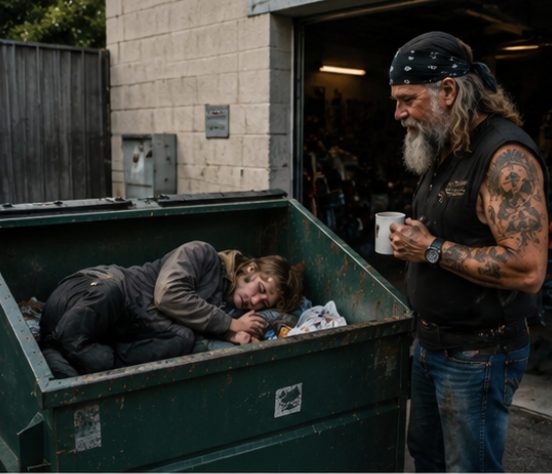
Then, one freezing morning, Big Mike found me curled up inside the dumpster behind his motorcycle shop.
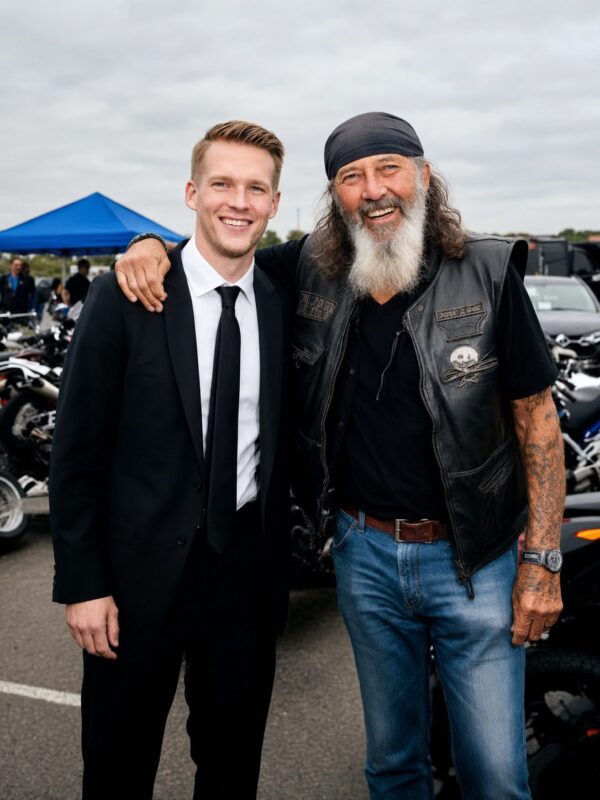
He was six-foot-four, covered in military tattoos, and had grease permanently trapped beneath his fingernails. He looked terrifying.
But instead of calling the police, he opened the shop door and said five words that changed my life:
“You hungry, kid? Come inside.”
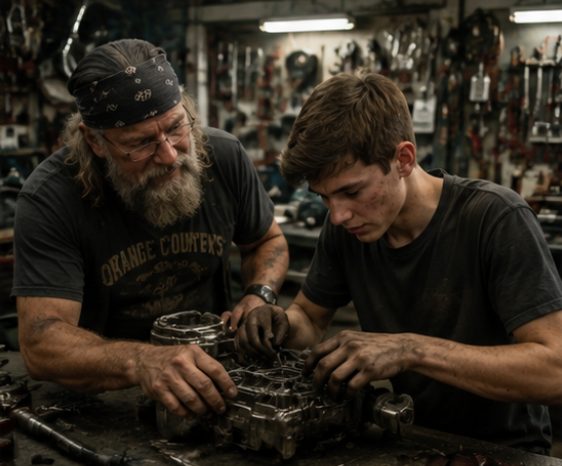
Mike gave me food, taught me how to repair engines, and quietly left the back room unlocked so I would have somewhere safe to sleep.
The bikers who gathered at his shop looked like dangerous men, but they became the family I had never known. They taught me mathematics, helped me read, bought me clothes, and eventually sacrificed more than I ever realized to send me to college.
Twenty-three years later, I became a successful lawyer.
Then I learned the city planned to seize Mike’s shop, claiming the bikers were degrading the neighborhood and contributing nothing to the community.
Mike believed he was about to lose everything.
But when I entered the courtroom in my three-piece suit and placed a thick folder before the judge, the city attorney’s confident smile disappeared.
Because inside that folder was proof of what Big Mike had really done—and one document even he never knew existed…
READ THE REST OF STORY IN THE FIRST COMMENT👇👇‼️
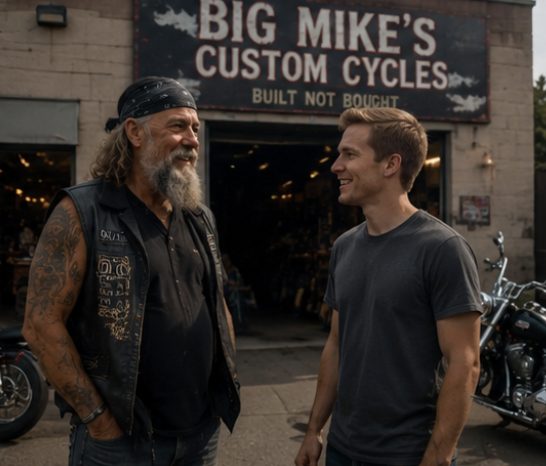
When I was fourteen, I ran away from my fourth foster home with nothing but a torn backpack and the clothes on my back.
I had survived bad homes before, but that one was different.
The foster father came into my room after midnight. His wife knew. She saw the fear in my face every morning, but she kept pouring coffee and pretending nothing was happening.
So one night, I climbed through the bathroom window and ran.
For three weeks, I slept behind stores, washed in gas-station bathrooms, and ate whatever I could pull from dumpsters. Whenever I saw a police car, I hid because I knew what would happen if they found me.
They would send me back.
One freezing morning, I crawled into the dumpster behind Big Mike’s Custom Cycles and curled between two garbage bags.
I woke to the sound of heavy boots scraping against the pavement.
When I opened my eyes, the largest man I had ever seen was staring down at me.
He stood six-foot-four, had a beard that reached his chest, and wore a sleeveless shirt that revealed faded military tattoos covering both arms. His hands were black with grease, and his expression was impossible to read.
I expected him to shout.
Instead, he opened the shop door and said five words that saved my life.
“You hungry, kid? Come inside.”
Everyone called him Big Mike.
He handed me a cup of coffee and the sandwich he had packed for himself. Then he pointed toward a pile of tools.
“You know how to hold a wrench?”
I shook my head.
“Want to learn?”
That was how it began.
Mike never asked why I had been sleeping in his dumpster. He never demanded an explanation or threatened to call the police.
He gave me small jobs.
I swept the floor, organized tools, cleaned oil stains, and carried boxes of parts. At the end of the day, he placed twenty dollars in my hand.
That evening, he locked the front door but somehow forgot to lock the back room.
Inside was an old military cot with a folded blanket on top.
He forgot to lock it again the next night.
And the night after that.
Soon, the bikers who gathered at the shop noticed the skinny kid who was always sweeping floors.
They looked terrifying.
They wore leather vests, skull patches, heavy boots, and expressions that made strangers cross the street. Their motorcycles roared so loudly that the windows shook whenever they arrived.
But instead of frightening me, they started taking care of me.
Snake taught me math using engine measurements.
Preacher made me read repair manuals aloud while he worked and corrected every word I mispronounced.
Bear’s wife brought me bags of clothes that her “son had outgrown.”
Her son was forty-two years old.
Every shirt fit me perfectly.
Six months after I arrived, Mike found me cleaning the back room.
“You got somewhere else to be, kid?” he asked.
I stared at the floor.
“No, sir.”
He nodded toward the cot.
“Then you’d better keep this room clean. Health inspector doesn’t like mess.”
That was the closest Big Mike ever came to telling me I could stay.
From that moment on, the motorcycle shop became my home.
Mike made sure I went back to school. He attended every meeting with my teachers, even though he always stood awkwardly in the hallway wearing boots that left grease marks on the floor.
When I graduated, he sat in the front row beside Snake, Bear, and Preacher.
They cheered louder than anyone.
Years later, I was accepted into law school.
I nearly refused because the tuition was impossible.
Mike told me not to worry.
“Engines break,” he said. “People break too. Maybe you can learn how to fix the things a wrench can’t.”
I did not know until much later that he had sold the custom motorcycle he had spent seven years building to pay my first semester’s tuition.
I became a lawyer.
Then a senior partner at one of the most respected firms in the state.
But the higher I climbed, the more embarrassed I became by where I had come from.
At law school dinners, when people asked about my family, I called Mike “an old family friend.”
At the firm, I avoided mentioning the motorcycle shop.
I wore expensive suits, drove a polished car, and carefully removed every trace of the dumpster kid I had once been.
Mike never complained.
Whenever I visited, he simply handed me a wrench and said, “Suit doesn’t mean your hands stopped working.”
Then the city announced plans to redevelop the neighborhood.
Developers wanted luxury apartments, restaurants, and offices. Big Mike’s shop stood directly in the middle of the proposed construction site.
The city called it unsafe, disruptive, and a blight on the community.
Their report claimed the bikers attracted crime and lowered property values.
They offered Mike a fraction of what the property was worth.
He refused.
So they took him to court.
When Mike called me, his voice sounded smaller than I had ever heard it.
“Don’t need you to do anything,” he said. “Just thought you should know they’re taking the shop.”
I was silent for a long moment.
That shop was where I had eaten my first safe meal.
Where I had slept without fear.
Where men the world called dangerous had taught me to read, work, and believe I deserved a future.
“I’m representing you,” I said.
The courtroom was packed on the first day of the hearing.
The city’s attorney presented photographs of motorcycles lined along the sidewalk, oil-stained floors, and men in leather jackets.
“This establishment contributes nothing of meaningful value to the neighborhood,” he told the judge.
Big Mike sat beside me in his oldest leather vest.
He looked uncomfortable in the polished courtroom.
When the city finished its case, I stood.
“My name is David Carter,” I began. “I am a senior partner at Carter, Mills and Hall.”
The city attorney smiled impatiently.
Then I removed my glasses.
“But before that, I was a fourteen-year-old foster child sleeping in the defendant’s dumpster.”
The room became completely silent.
Mike turned toward me.
I had never told the story publicly before.
I told the judge about the sandwich.
The cot.
The unlocked door.
The men who had taught me mathematics, reading, discipline, and dignity.
Then I called my witnesses.
A doctor testified that Mike had taken her in when she was sixteen and living in her car.
A teacher described how the bikers had paid for his community-college textbooks.
A social worker admitted that Mike’s back room had quietly sheltered dozens of teenagers who had nowhere safe to sleep.
One by one, successful adults walked into that courtroom and described the same thing.
A sandwich.
A wrench.
A second chance.
Finally, I placed a thick folder before the judge.
Inside were school records, letters, photographs, receipts for tuition payments, and statements from thirty-seven people Mike had helped over four decades.
The final document was a deed.
Years earlier, one of the people Mike had rescued had transferred part ownership of the property to a nonprofit trust dedicated to protecting vulnerable young people.
The city could not legally seize it for private redevelopment.
Their attorney’s confident expression vanished.
I turned toward the judge.
“The city calls this shop a blight,” I said. “But this so-called blight produced doctors, teachers, social workers, mechanics, and at least one lawyer.”
I looked at Mike.
“If that makes his shop a danger to the community, then perhaps we need to redefine what community means.”
The judge ruled in our favor.
Big Mike’s Custom Cycles would remain open.
Afterward, reporters crowded around us outside the courthouse.
Mike ignored them.
He pulled me into a hug so tight that I could barely breathe.
“You never told me you found out about the motorcycle,” he whispered.
“You never told me you sold it.”
He shrugged.
“Kid needed school more than an old man needed another bike.”
Months later, I visited the shop wearing jeans and an old shirt.
A police officer stood near the entrance beside a frightened fifteen-year-old boy who had been caught trying to steal tools.
The officer asked Mike whether he wanted to press charges.
Mike studied the boy’s hollow face.
Then he looked toward me.
I already knew what he was going to say.
“You hungry, kid?”
The boy nodded.
Mike opened the door.
“Come inside.”
And as the boy stepped into the warm shop, I finally understood that Mike had never rescued only me.
He had created a place where people the world had thrown away could learn that they were still worth saving.
Today, I keep a three-piece suit in my office and a wrench in the trunk of my car.
Sometimes I stand in courtrooms.
Sometimes I stand beside Mike beneath a motorcycle with grease under my fingernails.
And whenever anyone asks who raised me, I no longer call him a family friend.
I tell them the truth.
My father was a dirty mechanic who found me inside a dumpster.
He did not share my blood.
He never signed adoption papers.
But when the whole world had thrown me away, he was the one man who refused to leave me there.