I Came Home From a Work Trip and Found 100 Roses Covering Our Porch for My Wife… I Was Sure Someone Had Been Visiting Her While I Was Gone, Until I Opened One Hidden Note 💔🌹
When I came home from a week-long work trip, I expected to see my wife, Jane, waiting on the porch like she always did.
But this time, the porch was empty.
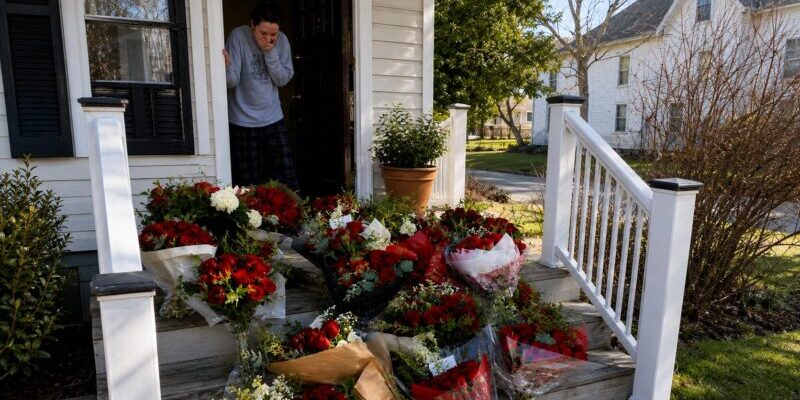
And it was covered in roses.
Not one bouquet. Not five. Dozens of them. Red, white, pink, yellow — so many flowers that our front door looked like the ending of a secret love story I had never been part of.
My stomach dropped.

Jane had been home alone while I was gone. I had trusted her completely. But standing there, staring at nearly one hundred roses waiting for her, every dark thought I had ever tried to ignore came rushing into my mind.
Then Jane opened the door.
She looked just as shocked as I was.
“What did you do?” she whispered.
But I had not sent them.
And when I asked who had, her face filled with confusion… then hurt. She could see what I was thinking, even before I said it.
I wanted to believe her. I wanted to stay calm.
Then I noticed a small white envelope hidden inside one bouquet.
My hands were already shaking when I opened it.
I expected a name. A confession. Proof that my marriage was not what I thought it was.
But the note inside had only three simple sentences.
And when I read them aloud, my wife covered her mouth, broke down crying, and I realized those roses had not come to destroy our marriage…
They had come to reveal something neither of us had seen coming.
READ THE REST OF STORY IN THE FIRST COMMENT👇👇‼️
I knew something was wrong before I even turned off the engine.
For seven years, every time I came home from a work trip, my wife, Jane, was already waiting on the porch.
It did not matter if I was gone for two days or seven. It did not matter if it was raining, snowing, or the middle of a hot summer afternoon. Jane always came outside before I even finished pulling into the driveway.
Sometimes she waved both hands like a child.
Sometimes she stood barefoot in one of my old sweaters, smiling like the house had been holding its breath until I returned.
That little tradition had become one of the safest parts of my life.
But this time, the porch was empty.
I slowed the car, frowning.
“Jane?” I muttered under my breath.
Then I saw the flowers.
At first, I thought maybe there were three or four bouquets by the front door. Strange, but not impossible. Maybe someone had sent them to the wrong house. Maybe Jane had bought them for something and forgotten to bring them inside.
But as I drove closer, my hands tightened around the steering wheel.
The porch was covered.
Bouquets were stacked against the railing. Others leaned against the door. Some were placed on the steps, others on the porch swing where Jane usually drank coffee in the mornings.
Red roses. White roses. Pink roses. Yellow roses.
Dozens of bouquets.
Maybe a hundred roses in total.
The whole porch looked like someone had tried to drown my wife in romance while I was gone.
My stomach twisted.
I parked too sharply, grabbed my suitcase, and got out of the car.
The smell hit me instantly — sweet, heavy, overwhelming. It should have been beautiful. Instead, it made something cold settle in my chest.
I had been away for a week.
My wife had been home alone.
And now our porch looked like a love confession.
I was still standing there when the front door opened.
Jane appeared in the doorway wearing jeans, a faded cardigan, and the tired expression she had carried for months. The moment she saw me, her face brightened.
Then her eyes dropped to the roses.
She froze.
“Mark,” she breathed. “What did you do?”
I stared at her.
“What did I do?”
She stepped outside slowly, looking around as if the flowers might explain themselves.
“You didn’t send these?”
“No,” I said, my voice sharper than I wanted. “I just got home.”
Jane blinked. “Then who sent them?”
That question landed between us like a stone.
I tried to laugh, but there was no humor in it.

“I was hoping you could tell me.”
Her face changed.
The happiness of seeing me disappeared. In its place came confusion, then fear, then hurt.
“Mark,” she said carefully, “I don’t know.”
I looked at the flowers again.
A hundred roses.
A hundred.
People did not accidentally send one hundred roses to a married woman.
“Maybe it was a delivery mistake,” she whispered.
“A very personal mistake,” I said.
She flinched.
“Don’t say it like that.”
“Like what?”
“Like you already believe something terrible.”
I looked away first, because she was right.
The thought had already entered my mind. I hated myself for it, but I could not stop it.
Who sends this many roses to another man’s wife?
Who had been thinking about Jane while I was gone?
Who knew I was away?
Jane wrapped her arms around herself.
“You really think I would hide something like this from you?”
“I don’t know what to think.”
The second I said it, I regretted it.
Her eyes filled with tears, but before either of us could speak again, I noticed something.
A small white envelope was tucked inside one bouquet near the porch swing.
It had no name on the outside.
Only a crooked little heart drawn in blue marker.
My heartbeat became loud in my ears.
There it was.
The proof.
The thing I both wanted and did not want to find.
Jane whispered, “Mark…”
But I was already bending down.
I pulled the envelope free, turned it over in my hands, and opened it.
Inside was a folded note.
For one terrible second, I imagined what it might say.
I miss you.
Last week was beautiful.
He will never love you like I do.
My hands tightened around the paper.
Then I unfolded it.
The first thing I noticed was the handwriting.
It was not smooth.
It was not elegant.
It was not the handwriting of a man trying to seduce my wife.
The letters were large and uneven. Some floated above the line. Others dipped below it. A few words were misspelled and corrected with tiny scribbles.
A child’s handwriting.
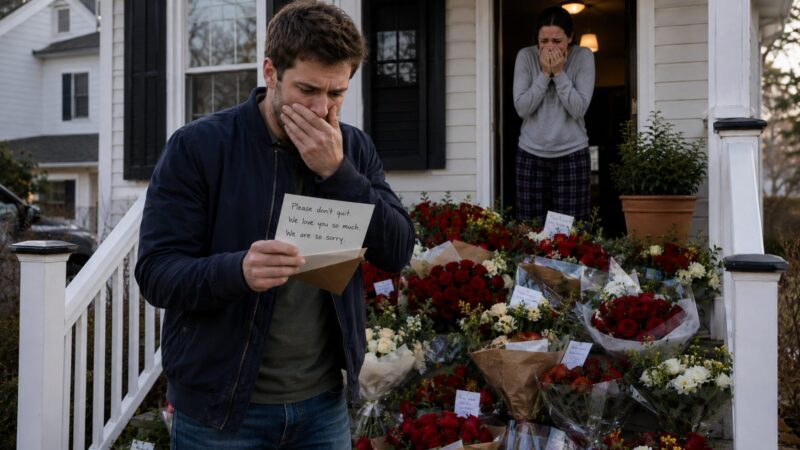
I read the first sentence.
My throat closed.
Jane stepped closer.
“What does it say?”
I swallowed, but my voice still cracked when I read it aloud.
“Please don’t quit.”
Jane’s hand flew to her mouth.
The words hit her like a wave. Her eyes widened, and suddenly she did not look confused anymore.
She looked devastated.
I looked back down at the note.
The second sentence was even worse.
“We love you so much.”
Jane made a small sound, almost like a sob.
My hands began to shake.
Then I read the third sentence.
“We are so sorry.”
For a moment, neither of us spoke.
The porch was silent except for the rustle of plastic wrapping in the wind.
I looked at Jane.
She was staring at the note as if it had opened a door inside her that she had been trying to keep shut.
“No,” she whispered.
Then she shook her head.
“No… they didn’t.”
“Jane,” I said quietly. “Who?”
She reached for the note with trembling fingers. When she read it herself, her face broke completely.
She began to cry.
Not softly.
Not politely.
She cried like someone who had been holding herself together for months and had finally run out of strength.
I dropped my suitcase and wrapped my arms around her.
“Hey,” I whispered. “Talk to me. What is this?”
But she could not answer at first.
She just buried her face in my chest and cried while I stood there surrounded by roses, feeling the shame of every suspicious thought I had just allowed into my mind.
Then I saw the cards.
Almost every bouquet had one.
Small notes. Names. Messages.
Some were written by adults. Others were written in the same uneven handwriting as the first note.
Children’s handwriting.
I picked up another card.
“Thank you for helping Ethan believe in himself.”
Jane sobbed harder.
I picked up another.
“Thank you for never giving up on Sophia.”
Another.
“School is better because you are there.”
My chest tightened.
“These are from your students,” I said.
Jane nodded, tears streaming down her face.
That was when everything made sense.
For months, I had watched my wife disappear piece by piece.
Jane was a teacher. Not just by profession — by heart. She loved her students in a way I did not fully understand until that day. She remembered their birthdays, their favorite books, their fears, their dreams. She bought supplies with her own money. She stayed up late grading papers and planning lessons. She came home exhausted but still worried about the child who had been too quiet in class or the one who had stopped turning in homework.
But that year had nearly broken her.
The pressure. The disrespect. The endless messages. The meetings. The feeling that no matter how much she gave, it was never enough.
More than once, I had found her sitting at the kitchen table after midnight with tears in her eyes.
“I can’t keep doing this,” she had whispered one night.
I had told her she was strong.
But strength was not the problem.
She was tired of being invisible.
A few weeks before my trip, Jane had sent one honest message to the parents of her class. She told them she loved teaching, but she was exhausted. She admitted she was struggling. She wrote that if things did not change, she might have to leave.
After sending it, she regretted it immediately.
“Teachers aren’t supposed to admit they’re drowning,” she had said.
Now I looked around at the porch.
At the roses.
At the cards.
At the proof that people had heard her.
Jane knelt beside one bouquet and opened another note.
Her voice shook as she read it.
“Dear Mrs. Carter, please don’t quit because you make math less scary.”
She laughed through her tears.
Then she opened another.
“My daughter talks about you every night. You matter more than you know.”
Another.
“You saw my son when nobody else did.”
Another.
“You are the reason my child still believes school can be safe.”
The more cards we opened, the more Jane cried. But slowly, something changed in her tears.
At first, they were tears of pain.
Then they became tears of relief.
For months, she had believed she was failing.
But all around her were one hundred reminders that she had not failed at all.
One hundred roses.
One hundred thank-yous.
One hundred voices saying: we see you.
We spent the next hour sitting on the porch steps, reading every note.
My suitcase stayed where I had dropped it.
The car door remained unlocked.
Dinner was forgotten.
None of it mattered.
Jane held each card like it was something precious. With every message, I watched a little bit of light return to her face.
Then, beneath the final bouquet, she found one last envelope.
This one was larger.
Inside was a card signed by dozens of names — students, parents, entire families.
At the bottom, someone had written one final message.
Jane read it aloud, her voice barely above a whisper.
“The world needs teachers like you. Please don’t give up on us, because we haven’t given up on you.”
The room — the porch, the whole world — seemed to go still.
Jane pressed the card to her chest and cried again.
I wrapped my arms around her.
This time, I cried too.
Because I had come home and thought the roses meant betrayal.
I had looked at my wife and let doubt enter my heart.
But those flowers had not been sent by a man trying to steal her from me.
They had been sent by children and families trying to give her back to herself.
Later that night, after we carried every bouquet inside, our house looked like a flower shop. Roses filled the kitchen, the dining room, the living room, even the hallway.
Jane stood in the middle of it all, turning slowly.
For the first time in months, she smiled.
A real smile.
The kind that reached her eyes.
“I was really going to quit,” she admitted.
“I know,” I said.
“I had already started looking for other jobs.”
I took her hand.
“And now?”
She looked at the roses.
Then at the cards.
Then at me.
“I think I need to show up on Monday.”
I laughed softly.
“You think?”
She laughed too.
And that sound filled the house in a way I had not heard for a long time.
That night, we sat together on the couch, surrounded by flowers and notes. I kept thinking about the moment I had pulled into the driveway and felt jealousy burn through me.
I had thought the roses were proof that someone else loved my wife.
I was wrong.
They were proof that hundreds of people did.
Not in the way I feared.
In the way she desperately needed.
And while Jane had spent every day teaching her students, they had taught her something too:
That sometimes love does not arrive loudly.
Sometimes it arrives as one hundred roses on a quiet porch.
And one small note that says exactly what a broken heart needs to hear.
Please don’t quit.